
Maria Gutu, Ph.D., Technical University of Moldova
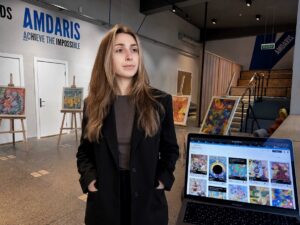 URSU Adriana, Technical University of Moldova
”Ursu Adriana is a PhD student and university assistant at the Technical University of Moldova, specialising in augmented reality technologies and immersive educational environments. Her academic and research activities focus on integrating augmented reality into education and developing interactive digital learning experiences. She is actively involved in educational and technological projects that promote innovative teaching approaches through immersive technologies.
During the workshop, Adriana will demonstrate the process of creating an interactive augmented reality experience using the ARTIVIVE platform and will guide participants through the practical stages of AR content development for educational and creative applications.”

Dr. Cristina Obae, NEdHo (New Education Horizons), Romania
University of Brescia, Italy
 Manuela Milani is currently advising on the creation of the Teaching and Learning Centre at the University of Brescia (Italy) and supporting innovation and the enhancement of teaching practices at Charles University (Prague, Czech Republic). She previously worked as an Academic Developer at the University of Milan. For over 20 years, she has been involved in faculty development in higher education, contributing to several European projects aimed at sharing tools and methods for professional growth. In recent years, she has designed and led numerous training initiatives for university teachers, with a particular focus on fostering reflective skills. She has published several articles on the use of cultural differences in teaching, on teaching observation, and on faculty development design.
Keynote speech: Designing for Whom? Motivational Diversity, Needs Analysis, and Training the Trainers First
Digital fluency initiatives are often designed for an imagined average learner. Yet digital fluency is not a fixed target — its meaning and relevance shift considerably depending on who the learner is and what their context demands. The populations targeted — teachers, practitioners, NGO workers, women re-entering education or the workforce, and displaced individuals — are motivationally heterogeneous, yet this diversity is rarely captured in needs analysis processes, which tend to focus on skills gaps while systematically underweighting motivational profiles.
This matters because motivation is not a soft variable — it is a design variable that shapes both the entry point and the expected outcome. When motivation is intercepted early, it becomes possible to identify which components of digital fluency are truly relevant for a given learner — and to build from there. Once those components are acquired, they can trigger a virtuous cycle of further learning. Ignored, motivation leaves the process sterile, and the full architecture of digital fluency remains out of reach.
The root cause lies one step further upstream. Trainers and instructional designers are themselves rarely prepared to conduct motivationally-informed needs analysis. They inherit frameworks that treat motivation as a given, rather than as the starting point of any meaningful design process.
This session proposes a reorientation: needs analysis frameworks that explicitly incorporate motivational mapping, and trainer preparation programs that equip educators to use them. Building genuinely inclusive digital fluency for youth, women, and displaced communities alike requires, first and foremost, training the trainers to ask better questions.
NEdHo (New Education Horizons)

Dr. Cristina Obae is AI and Virtual Worlds advisor at NEdHo (New Education Horizons), involved in new technologies-based learning environments research at the University of Lapland. With more than 20 years’ experience in education, she is an active Digital Education Ambassador, involved in multiple innovative EU projects, has lead the Hybrid Learning Squad and has been invited as expert in all of the European Digital Education Hub Squads on AI, Future classrooms, Sustainability, Immersive Learning and Futuring.
Keynote speech: From Classrooms to Learning Environments: Designing Multimodal Ecosystems for Future-Ready Education
What if the biggest barrier to future-ready education is not the lack of technology but the way we still think and see the classroom?
Education systems continue to be built around a model that no longer reflects reality. Learning today happens everywhere: in physical spaces, online platforms, and increasingly in immersive, AI-supported environments. Yet we still design education for just one room. The result is a growing mismatch between how people learn, the skills they need, and how education is structured.
These new learning environments we constantly see emerging are powerful, but also extremely complex. They are shaped by technology, pedagogy, institutional rules, cultural expectations, and the diverse realities of learners. AI is rapidly becoming part of this ecosystem, enabling personalised learning, real-time feedback, and new forms of interaction. But technology alone does not transform education. Design does.
And design is not neutral. It determines who can access learning, how students engage, and what skills they develop. Well-designed learning environments can foster critical thinking, collaboration, digital fluency, and adaptability, key competencies for navigating modern uncertainty. They can also open opportunities, especially for youth, women, and displaced communities. Poorly designed ones, however, risk reinforcing inequalities and limiting skill development. The role of the teacher is thus shifting from delivering content to designing and orchestrating learning ecosystems, working with AI tools and multidisciplinary teams. This requires new competencies: communication, collaboration, design thinking, and the ability to manage risk and adapt within complex environments.
Grounded in the speaker’s state-of-the-art research on immersive and hybrid learning environments, and in the collective work of the European Digital Education Hub – Squad on the Future Classroom (a European Commission initiative), this keynote offers a clear lens to understand education’s future transformation.
This session invites a shift in perspective: not how to improve classrooms, but how to design learning environments that build the right skills for the future.
Because the future of education is not just about where learning happens. It is about what learners are able to do, and who they are able to become, within the environments we design.
Ignatium University of Krakow, Poland

Michael Doherty is an academic teacher at Ignatianum University in Kraków, Poland, where he teaches courses to undergraduate and graduate students in English language, academic skills, and aspects of British and Irish history and culture. With over twenty years’ experience across primary, secondary, tertiary and adult education, he has worked extensively in English language teaching, syllabus design, and materials development. His professional interests include assessment, educational technology, the use of artificial intelligence in education, and the ways in which digital tools shape teaching and learning. Since 2022, he has presented regularly at conferences on issues relating to language education and contemporary developments in educational practice.
Keynote speech: Who shapes the future of Education? Democratic value in the age of AI
Since the public launch of ChatGPT in 2022, artificial intelligence has become impossible to avoid in discussions of education. Promoted by some as a revolutionary technology and dismissed by others as a passing fad, AI has generated more heat than light. Yet beyond the headlines, educators are faced with a series of practical and philosophical questions. What tools should students be allowed to use? How should learning be assessed? Who benefits from these technologies and who is left behind? And perhaps most importantly, who gets to decide?
Drawing on recent international research, policy developments and examples from educational practice, this keynote examines some of the opportunities and challenges associated with the growing presence of AI in education. It explores student attitudes towards AI, questions of equity and access, the limitations of AI detection, and the increasing importance of transparency in both educational policy and technological design.
The session also considers a wider issue. Much of the current discussion assumes that the expansion of AI into education is both inevitable and desirable. But education has always involved more than the efficient delivery of information. Classrooms are social spaces in which learners develop critical thinking, creativity, judgement and the ability to engage with others. These are not simply technical outcomes that can be automated or optimised.
Rather than asking whether AI is good or bad for education, this keynote argues that we should ask different questions: whose interests are being served, whose voices are being heard, and what kind of educational future we wish to create. If AI is to play a meaningful role in education, then educators, learners and communities must remain active participants in shaping that future rather than being passive recipients of it.